After the
billion-dollar performance of
Alice in Wonderland
earlier this spring, Disney executives must have been thinking that 2010 would be a record setting year for the studio at the box office. With
Toy Story 3 and
Tron: Legacy still to come, that may yet be the case. But with Memorial Day weekend now behind us, it’s clear that Disney’s path to box-office glory has hit a speed bump.
Prince of Persia: The Sands of Time was supposed to be the next big Disney franchise. Based on a popular
video game
,
Prince of Persia was an opportunity to launch a new adventure series in the mold of
Pirates of the Caribbean
that would appeal to audiences of all ages, spawn multiple sequels, sell shelves of merchandise, and maybe even inspire new attractions in the parks. The film had a promising pedigree, with hit-maker Jerry Bruckheimer producing and Harry Potter
veteran Mike Newell directing. Leading up to its opening weekend, the marketing was so ubiquitous that clearly no expense was spared. Alas, the film
opened in second place for an anemic $37.8 million for the four-day Memorial Day weekend (only $30 million for the Friday to Sunday period).
Prince of Persia, which cost an estimated $200 million to make and heaven only knows how much to market, will be lucky to gross even $100 million at the domestic box office, and so this new franchise is already over before it got started.
Ironically,
Prince of Persia was conceived, at least in part, as sort of a replacement for another adventure franchise that Disney had chosen to abandon for its perceived poor performance. 2005’s
The Chronicles of Narnia: The Lion, the Witch and the Wardrobe
ended up as one of Disney’s
biggest all-time hits, with a domestic gross of nearly $300 million and a global gross of over $700 million. With Narnia, Disney had seemingly found its own family-friendly, fantasy-literary series on par with Harry Potter or
The Lord of the Rings.
But unlike the Harry Potter franchise, which has released nearly all of its films on a compressed 12 or 18-month schedule, there was a gap of two and a half years between
Lion and its sequel,
The Chronicles of Narnia: Prince Caspian

.* In addition,
Prince Caspian was pushed from the holiday release date that had served its predecessor so well and was released in May 2005, the start of the summer movie season, right between the much buzzed-about
Iron Man
and the intensely anticipated
Indiana Jones and the Kingdom of the Crystal Skull
. To make matters even worse, the film was marketed badly . Instead of building on the goodwill held toward the first film and the returning characters, Disney pushed
Prince Caspian as a dark and intense action movie and tried to position the new title character as a teen heartthrob.
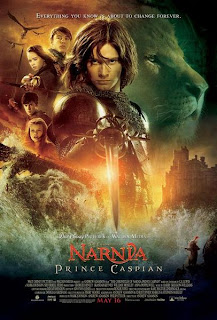
With the long gap between films, the unfavorable competition and an ill-suited marketing effort,
Prince Caspian unsurprisingly debuted to a soft $55 million on its way to a
total domestic box office take of $141 million and a total global box office haul of $419 million.** Given that this was far below the performance of the first Narnia film, Disney re-considered its commitment to the franchise. The decision was complicated by the fact that Disney shared the costs and profits for the Narnia films with Walden Media, which actually controls the rights to the books. Walden Media had already begun pre-production on the third Narnia film,
The Voyage of the Dawn Treader
, which was originally slated to be released in May 2010. After haggling with Walden over budget costs, release dates and other issues, Disney walked away from the partnership and Walden will now release
Dawn Treader in December with 20th Century Fox.
Prince of Persia was then fast-tracked by Disney to fill the May 2010 slot and here we are.
In hindsight, Disney would have been much better off sticking with the Narnia franchise instead of trying to build a new franchise from scratch. While both
Prince of Persia and
Prince Caspian cost north of $200 million to produce, Walden had agreed to scale back the budget for
Dawn Treader to something in the range of $140 million. Furthermore, Disney would have only been on the hook for half of that because it shared the financial risk (and reward) for Narnia with Walden Media, limiting its exposure in the event of failure. With
Prince of Persia, Disney shoulders all of the loss on its own but would have probably been obligated to make significant payouts to Bruckheimer had the film been a success. With regard to marketing costs, it’s always easier to sell an existing brand then to introduce something new and unknown to the masses.
Finally, the fact the Narnia is already an established brand with at least one well-regarded and popular film to serve as an anchor makes it easier to profit from subsequent films, regardless of how successful they are at the box office.*** The release of a new franchise film inevitably reinvigorates interest in the older films resulting in new sales of DVDs and other merchandise. Simply the ability to
bundle
the films together as a new box set of the "Narnia Trilogy" could provide new revenue. And because of Narnia’s
literary roots
roots
, it has a much higher likelihood of enduring as an “evergreen” property that can sustain ventures long after the movies are done, such as theme park attractions.****
In this tale of two princes, Disney simply chose the wrong prince. Had
Dawn Treader been released by Disney in place of
Prince of Persia, it is very plausible that it would have out-performed
Prince Caspian or at the least done no worse than
Prince of Persia. But Disney would have spent less money overall and had more opportunity for ancillary revenue. Nonetheless, I have a feeling that a certain cowboy and space ranger will still
provide a fairy tale ending for Disney’s summer.
* The tight release schedule serves three purposes: 1) it maintains public interest in the franchise, particularly among fickle younger movie goers; 2) it achieves some efficiency in production costs; and 3) it ensures that the young actors don’t age beyond their characters in between films.
** Although Prince of Persia has debuted to a decent start in international markets and could still prove to be a success in that regard, its opening weekend abroad was 17% lower than the foreign debut of Prince Caspian.
*** It's worth noting that among fans of Narnia, Dawn Treader is widely considered to be the most popular book in the series, while Prince Caspian is generally one of the least popular.
**** Disney created a temporary walk-through attraction the Narnia films at Disney’s Hollywood Studios in Orlando. Rumors of a permanent Narnia-themed attraction have percolated on Disney fan message boards for years.
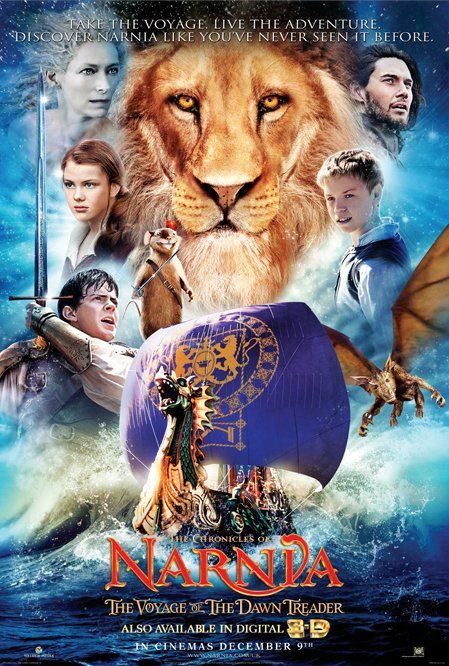
 took in on its opening weekend in 2008, despite the fact that Dawn Treader had the benefit of higher 3D ticket prices. When Fox took over for Disney as Walden Media's partner for the Narnia series, they hoped that they could resuscitate the Narnia franchise by returning to the formula that seemed to work for The Lion, the Witch and the Wardrobe
 . And each of the subsequent books in the series stand alone as a self-contained stories. This leaves only the die-hard Narnia fans to keep coming back.


 and
and  have easily surpassed whatever high expectations anyone might have set for them. When you add in the success of
  , which was distributed by Paramount but produced by Disney-owned


